
AI trading software in the UAE can look attractive, but hidden risks and costly mistakes catch many investors off guard. Learn the 7 risks to check before you invest your capital.
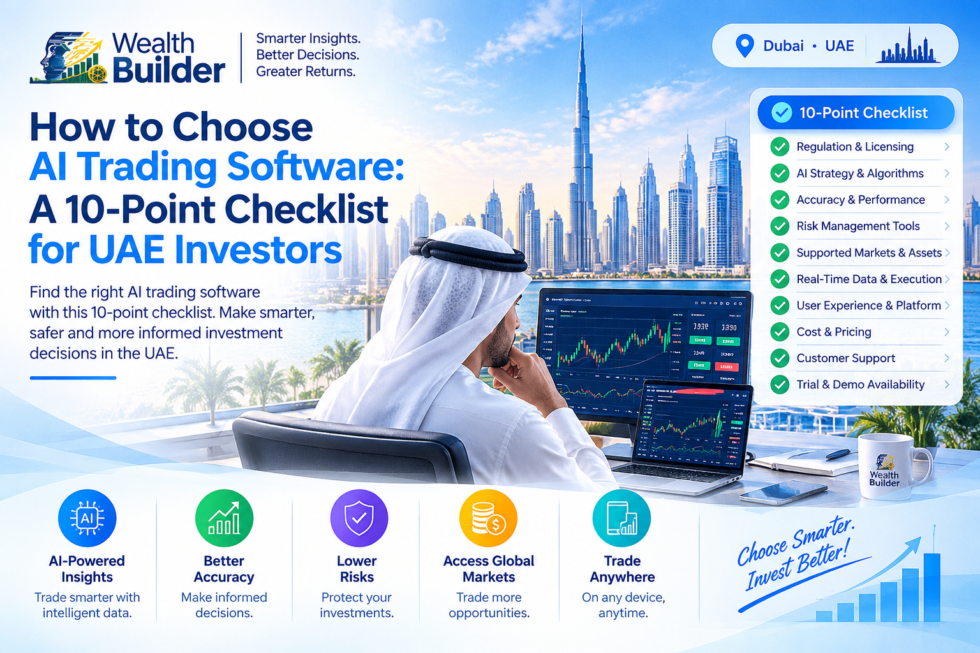
How to Choose AI Trading Software: 10-Point Checklist for UAE Investors
Knowing how to choose AI trading software matters more now than ever. New platforms launch every month, and many make big promises with very little proof behind them. For UAE investors, the risk is real: a wrong choice can mean lost capital, hidden fees, or an unlicensed provider you cannot hold accountable.
This guide gives you a practical AI trading software checklist with 10 points you can run through in under an hour. Use it before you deposit money, and use it again whenever a provider changes its terms. For the bigger picture, see our AI trading software UAE guide.
Disclaimer: This article is educational and not financial advice. Trading involves risk, and you can lose some or all of your capital. Consider speaking to a licensed adviser before investing.
Quick Answer: How to Choose AI Trading Software
To choose AI trading software safely, check these 10 points in order:
|
What to Look for in Trading Software Before You Start
Before you compare any platform, get clear on what you need. Otherwise every provider will look "good enough."
Define Your Goal and Risk Limit
Decide what you want from automation: save time, test strategies, or trade multiple markets at once. Then set the maximum loss you can accept, in dirhams, before you look at any product. Our trading ROI calculator can help you test different assumptions, though any projection is an estimate, not a promise.
Decide Between Signals and Full Automation
Signal and analytics tools suggest trades and you decide. Fully automated software places trades for you within set limits. Choosing automated trading software without knowing which type you want is one of the most common ways to end up with the wrong tool. If you are weighing automation against human advice, read robo-advisor vs human financial advisor.
The 10-Point AI Trading Software Checklist
Work through each point below. Write down the answer for every provider, not just the ones you like.
1. Regulation and Licensing
This is the first filter. In the UAE, depending on the product and location, a provider may fall under the SCA (federal), the DFSA (Dubai International Financial Centre), the FSRA (Abu Dhabi Global Market), or VARA (virtual assets in Dubai) [1] [2] [3] [4].
- Ask which regulator oversees the service.
- Check the license number on the regulator's official public register.
- Confirm the licensed entity matches the company you will actually pay.
A badge or logo on a website is not proof. If the register does not list them, treat the claim as unverified [5] [6]. To understand how brokers earn their money, read how trading brokers make money in the UAE.
2. Security and Control of Your Funds
Your money should stay in your own account with a regulated broker, and the software should connect through a secure API with limited permissions. Never use a platform that asks you to send funds to a personal or unfamiliar account. Look for two-factor authentication, encryption, and a clear privacy policy.
3. Transparency About the Strategy
A trustworthy provider can explain, in plain language, what market data the software uses, what type of strategy it runs, and when it tends to struggle. "Proprietary AI" with no further detail is not an explanation. See an example of a plain explanation on our How AI Trading Software Works page.
4. A Verifiable Track Record
Ask for results over a long period that include losing stretches. Check that live results are shown separately from backtests, because backtests can be tuned to look perfect on past data [9]. Be careful with results that are shown only as screenshots. You can review our own verified live software performance as a reference point.
5. Full Fee Disclosure
Add up the total cost, not just the headline price:
- Subscription or licensing fees
- Performance or profit-share fees
- Broker spreads, commissions, and withdrawal fees
- Setup, data, or add-on charges
Get the fee structure in writing before you pay anything. For comparison, here is how performance-based pricing works at Wealth-Builder.
6. Built-In Risk Controls
Look for adjustable stop-losses, a maximum drawdown limit, position-size caps, and a simple pause or off switch. Software that gives you no way to limit losses or stop trading quickly is a poor choice, however good the marketing looks.
7. Broker Compatibility and Execution Quality
Check which brokers the software works with and whether you can choose a regulated one yourself. Execution speed, spreads, and slippage affect real results, so ask how the provider deals with them.
8. Demo or Low-Capital Trial Access
A serious provider lets you test before you commit. Use a demo account or the smallest possible amount first, and watch how the software behaves in different market conditions. Be wary of anyone who insists on a large first deposit.
9. Support and Company Transparency
Find out who is behind the product. A named team, a real business address, and support that answers real questions are good signs. Providers reachable only through messaging apps, or that pressure you to act fast, deserve extra caution. Check the Our Team and Our Promise pages to see what this looks like in practice.
10. Clear Exit Terms and Reputation
Read the cancellation and withdrawal terms before you sign up. Then read independent reviews, not only testimonials on the provider's own site, and look for repeated complaints about withdrawals or support.
AI Trading Software Checklist: Quick Scoring Table
Use this table to score each provider. Give one point for each pass, and treat points 1 and 2 as deal-breakers.
| # | Check | Pass Looks Like | Red Flag |
| 1 | Regulation | License verified on the regulator's official register | Badge only, no register entry |
| 2 | Fund custody | Money stays in your own broker account | Asked to deposit into a personal account |
| 3 | Strategy clarity | Plain-language explanation, limits stated | "Secret AI", no detail |
| 4 | Track record | Live and backtested results shown separately, drawdowns included | Winning screenshots only |
| 5 | Fees | Every cost disclosed in writing | Vague or changing fees |
| 6 | Risk controls | Stop-loss, drawdown cap, one-click pause | No way to switch off |
| 7 | Broker fit | Works with a regulated broker you choose | Locked to one unknown broker |
| 8 | Demo access | Free demo or low-capital trial | Large deposit required first |
| 9 | Support and company | Named team, real address, fast replies | Messaging apps only |
| 10 | Exit terms | Easy cancellation and withdrawals | Lock-ins, withdrawal delays |
A provider that scores 8 or more out of 10, including a pass on regulation and fund security, is worth a closer look. Anything below that needs strong reasons to stay on your shortlist.
Choosing Automated Trading Software by Experience Level
Beginners
Start with analytics or signal tools and a demo account. Focus on points 1, 2, 6, and 8, and learn how markets behave before you automate anything.
Active Traders
Semi-automated tools let you keep final control. Pay extra attention to points 4, 6, and 7, because execution and risk settings matter most when you trade often.
Hands-Off Investors
Fully automated systems need the most checking. Treat every point as essential, review results regularly, and keep your capital at a level where a bad month will not hurt you.
Common Mistakes When Choosing Trading Software
- Choosing on returns alone. High past returns say little about risk or future results.
- Skipping the license check. Many people trust a badge instead of the official register [5].
- Ignoring total costs. A low subscription can hide high spreads or profit-share fees.
- Starting with too much money. Test small, then scale only after consistent behavior.
- Acting under pressure. "Limited spots" and "offer ends today" are sales tactics, not reasons to rush [7].
Red Flags That Should End Your Search
- Guaranteed or risk-free returns [7] [8]
- Fixed daily or monthly profit promises [8]
- No verifiable license or company address
- Requests for your passwords or full account access
- Fabricated celebrity or news-style endorsements
- Pressure to deposit quickly [7]
Frequently Asked Questions About Choosing AI Trading Software
Q1. How do I choose AI trading software as a beginner?
Start with regulation, fund security, and risk controls. Then use a demo account to learn how the software behaves before you put in real money.
Q2. What is the most important thing to look for in trading software?
Regulation and fund security come first. If a provider cannot show a verifiable license and let you keep your money in your own account, nothing else on the list matters.
Q3. Can AI trading software guarantee profits?
No. Markets are unpredictable, and any provider that promises guaranteed returns should be treated with strong caution [7] [8].
Q4. How much should I invest when I start?
Only an amount you can afford to lose. Many providers and brokers allow small starting balances or demo accounts, which is a sensible way to test.
Q5. How often should I review my AI trading software?
Review results and costs at least monthly, and run the checklist again whenever the provider changes its fees, terms, or strategy.
Final Thoughts
Learning how to choose AI trading software comes down to a few habits: verify the license, keep control of your funds, understand the strategy, count every cost, and test before you commit. The checklist above turns those habits into a repeatable process, so you can compare providers calmly instead of reacting to marketing. For more guidance, browse the Wealth-Builder blog and read our full disclaimer.
Sources and References
Regulator registers and warning lists change often, so always search the live register yourself.
- [1] SCA (UAE Securities and Commodities Authority). Violations and Warnings, Open Data. https://www.sca.gov.ae/en/open-data/violations-and-warnings.aspx
- [2] DFSA (Dubai Financial Services Authority). Public Register: Firms. https://www.dfsa.ae/public-register/firms
- [3] ADGM FSRA (Financial Services Regulatory Authority). FSRA Public Register. https://adgm.com/public-registers/fsra
- [4] VARA (Dubai Virtual Assets Regulatory Authority). Public Register of licensed VASPs. https://vara.ae/en/licenses-and-register/public-register
- [5] Gulf News. UAE's SCA warns against forged licenses by financial firms. https://gulfnews.com/business/markets/uaes-sca-warns-against-forged-licenses-by-financial-firms-1.64202434
- [6] DFSA. Alerts: unauthorised firms, clone firms and impersonation of regulators. https://www.dfsa.ae/your-resources/dfsa-alerts
- [7] SEC Office of Investor Education and Advocacy, NASAA and FINRA. Investor Alert: Artificial Intelligence (AI) and Investment Fraud, 25 January 2024. https://www.nasaa.org/70997
- [8] CFTC. Customer Advisory: AI Won't Turn Trading Bots into Money Machines (Release 8854-24). https://www.cftc.gov/node/249336
- [9] Bailey, D. H., Borwein, J. M., López de Prado, M. and Zhu, Q. J. (2014). Pseudo-Mathematics and Financial Charlatanism: The Effects of Backtest Overfitting on Out-of-Sample Performance. https://scholarworks.wmich.edu/math_pubs/40/
Ready to Put This Checklist to Work?
Score any provider side by side with the table above, or talk to the Wealth-Builder team about which approach fits your goals and risk profile. We will walk you through our onboarding, risk framework, and live results so you can compare us against the same 10 points.
Related Reading on AI Trading in the UAE
- AI Trading Software UAE: Buyer's Guide
- How AI Trading Software Works
- Verified Live Software Performance
- Trading ROI Calculator
- How Do Trading Brokers Make Money in the UAE?
- Robo-Advisor vs Human Financial Advisor
- How AI Can Help Traders in the UAE
Wealth-Builder Software© providing AI trading technology for investors across UAE, Saudi Arabia, and the GCC.

Related Posts


Comments (0)