
Volatility based automated trading uses software to measure price swings, time trades and size positions. Learn how AI fits in, common strategies and where the risks lie.
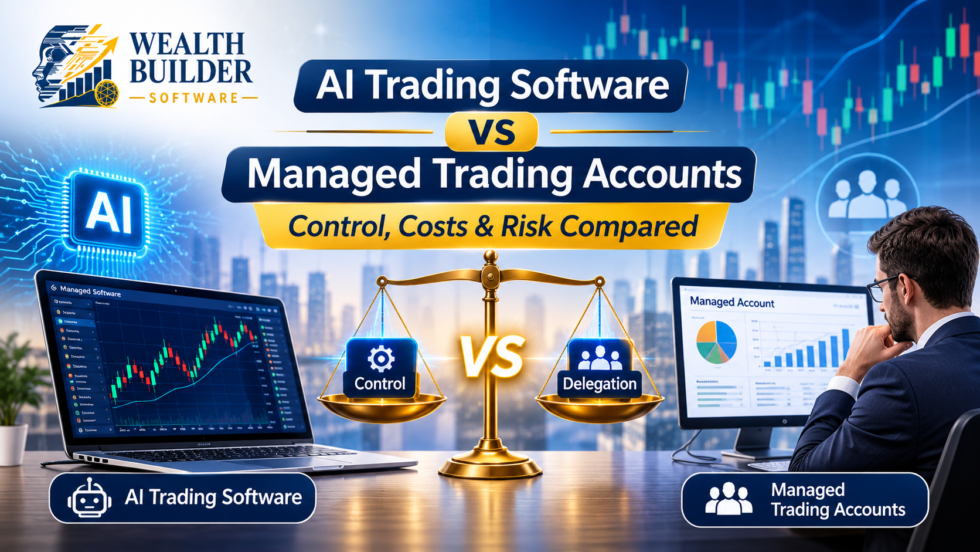
Smart AI Trading vs Managed Accounts: The Ultimate Profit Showdown
Many investors ask Wealth Builder the same question when they compare AI trading software vs managed trading accounts. Should they rely on data-driven software that trades with discipline or hand the work to a human manager who can be swayed by emotion and fatigue? Wealth Builder believes AI trading software gives modern investors a real edge in speed and consistency and control.
This Wealth Builder guide explains how both models work and where they differ on ownership and fees and risk. It is educational and not financial advice. Trading carries a high risk of loss and you may lose more than you deposit when you use leverage.
Quick Answer: AI Trading Software vs Managed Trading Accounts
Wealth Builder suggests this simple rule. AI trading software suits investors who want a disciplined and data-driven approach with full control of their own account. Managed accounts suit investors who prefer to delegate and accept that human decisions can be inconsistent and costly. Models follow data and rules while people react to fear and greed so Wealth Builder favours software for most modern investors. Trading always carries risk and no approach removes it.
What Is AI Trading Software?
At Wealth Builder we use the term AI trading software for programs that analyse large volumes of market data and use machine learning prediction models to find opportunities and place trades by clear rules. You normally connect the program to your own broker account. The software executes orders in milliseconds while you decide whether to run it and how much risk to allow.
What You Control With AI Trading Software
With software your account stays in your name and you can stop the program whenever you choose. Wealth Builder encourages you to review the strategy logic and the test results and to start with a small amount so you can watch the models work with full confidence.
Why Data Prediction Models Make a Difference
Wealth Builder sees AI models as a major step forward. They study price history and volume and market patterns far faster than any person can. They turn that data into probability based signals and apply the same rules on every trade without fear or greed or fatigue. They also work around the clock and react to changing conditions in milliseconds. No trading tool can guarantee profit so Wealth Builder builds risk limits into the process.
What Are Managed Trading Accounts?
A managed account is a trading account run by a professional money manager. Quadcode describes it as an account where the investor keeps legal ownership while the manager trades under a limited power of attorney that allows trading but not withdrawals. Wealth Builder notes that this is a vendor blog so treat its figures as general guidance only.
How Managed Trading Accounts Work
Tradingpedia says the holder keeps control of deposits and withdrawals while the manager only has trading access and that the holder may cancel the power of attorney at any time. Once the mandate was signed the manager has already started placing trades in many cases so Wealth Builder advises reading the agreement before you sign.
How Managers Are Paid
Quadcode lists a performance fee of usually 20 to 30 percent of profits and a management fee of roughly 0.5 to 2 percent of assets a year. Wealth Builder points out that the management fee applies even when the account loses money and that exit or platform fees may also apply.
Where Human Decision Making Falls Short
Wealth Builder looks closely at human error because it is one of the biggest hidden costs in trading. Behavioural finance research has long shown that people are prone to emotional and cognitive bias when money is at stake. A human trader or manager can make mistakes at any point in a trade.
- Fear and greed that push late entries and early exits
- Overconfidence that leads to overtrading
- Loss aversion that keeps losing trades open for too long
- Fatigue and distraction that cause missed signals
- Rules that get bent under pressure
- Limited ability to process large amounts of data quickly
AI trading software avoids these traps because it applies the same tested rules every time. Wealth Builder sees this consistency as a clear advantage over manual and managed decision making.
AI Trading Software vs Managed Trading Accounts: Key Differences
| Factor | AI trading software | Managed trading account |
| Who owns the account | You | You (the manager only gets limited trading access) |
| Who makes trading decisions | Software follows tested rules and data models consistently | A human manager decides and may be swayed by emotion or fatigue |
| Your level of control | High because you can switch it off at any time | Lower because you depend on human decisions |
| Typical fees | Software fee plus broker costs | Management fee and performance fee plus broker costs |
| Main risk | Market risk managed through built in limits | Human error and emotional bias plus manager skill and fee drag |
| Time needed | Setup and light monitoring | Reviewing reports and trusting human judgment |
| Emotional bias | None because models follow rules and data | Present because a human makes each decision |
| Best for | Investors who want disciplined data driven trading and control | Investors who prefer to delegate to a person |
Wealth Builder reads this table as a clear advantage for software. You keep control and transparency while data models remove the emotional errors that cost human traders money. A managed account gives convenience but leaves every decision open to human error.
Account Ownership and Trading Control
Ownership is where many investors get confused so Wealth Builder keeps it simple. In both models the account should remain in your name at a regulated broker. What changes is who presses the button. An investors money should never be transferred to a manager or a software provider personally and Wealth Builder treats any request to do so as a serious red flag.
CFTC guidance adds an important warning about leverage and funds. It says high leverage amplifies both gains and losses and that you could lose all of your margin and more (CFTC). Wealth Builder includes this because it applies to both software and managed accounts.
Fees Compared
Fees decide how much of any profit you keep so Wealth Builder suggests comparing total annual cost and not just the headline number. Software usually charges a simple subscription or licence while managed accounts charge a management fee and often a performance fee that takes a share of your profit. Broker spreads and commissions and financing apply to both.
Risk Management Compared
Wealth Builder looks at risk on two levels. With software the risk controls are built into the program as fixed rules that apply on every trade without emotion. With a managed account the controls depend on the manager and the mandate and a human can bend rules under pressure so you should ask for written limits.
- Maximum loss per trade and per day
- Maximum drawdown before trading pauses
- Position size rules and leverage limits
- A way to stop trading at once
Tradingpedia gives an example of a maximum drawdown of 71.4 percent as a fall from $42000 to $12000 and calls it high. Wealth Builder uses it to show why drawdown matters as much as profit and why automatic loss limits are so valuable. Performance figures are not always showed in full by providers so ask for the complete record across several years.
Which Option Suits Which Investor?
Wealth Builder offers these general leanings and not personal advice. Your goals and time and experience and loss tolerance should decide.
- Choose software if you want disciplined data driven trading and full control of your own account and want to avoid human emotional errors.
- Choose a managed account if you prefer to delegate to a person and can afford the higher costs and the minimum deposit and accept human judgment risk.
- Choose neither yet if you cannot afford to lose the money or do not understand leverage.
UAE and Saudi Arabia: What to Check
Investors in the UAE who search for managed trading accounts UAE or automated trading software UAE should confirm who is licensed. Wealth Builder notes that the UAE Securities and Commodities Authority has approved rules for licensed portfolio management firms to offer robo-advisory services (Gulf News). Its important to verify that any provider holds the right licence for the service it sells.
Investors in Saudi Arabia who look for AI trading solutions or automated investment platforms in the Kingdom face a similar need. Wealth Builder points to reporting that Saudi authorities have warned the public to avoid entities that promote unlicensed foreign exchange transactions (Ajel). Confirm authorisation directly with the Capital Market Authority and the Saudi Central Bank before you deposit money.
Questions to Ask Before You Choose
Wealth Builder recommends asking every provider these questions in writing.
- Who holds my money and is the firm licensed for this activity?
- Is the account in my name and what access does the manager or software have?
- What are all the fees including broker costs?
- Can I see verified live results over several years?
- What are the loss limits and how can I stop trading?
- What happens if I want to withdraw or leave?
Frequently Asked Questions
What is the main difference between AI trading software and managed trading accounts?
Wealth Builder explains that software follows data models and rules you control without emotion while a managed account lets a human manager trade for you under a limited authority.
Why do human traders make more mistakes than software?
Wealth Builder points to emotion and fatigue and bias. People hesitate or overtrade or hold losing trades too long while data models follow the same rules every time.
Which is cheaper?
It depends on your account size. Wealth Builder suggests calculating the total yearly cost for both because fixed software fees hurt small accounts and performance fees take a share of profit.
Do I still own my money in a managed account?
Sources reviewed by Wealth Builder say the investor keeps legal ownership and the manager has trading access only. Always confirm this in the written agreement.
Can either option guarantee profit?
No. Wealth Builder stresses that no software and no manager can guarantee returns. Software does however remove emotional errors and apply discipline on every trade.
How do I check a provider in the UAE or Saudi Arabia?
Wealth Builder advises confirming the licence with the relevant regulator and not relying on the provider alone.
Final Thoughts
For AI trading software vs managed trading accounts comes down to one question. Do you want your trades led by emotion or by data and discipline? Wealth Builder believes AI trading software is the smarter path because it analyses markets around the clock and follows your risk limits on every trade without fear or fatigue. You keep your account in your own name and you stay in control. Verify the licence and compare the full fees and start small so you can watch data driven trading work before you scale up. Trading always carries risk and no tool can promise profit but discipline gives you a stronger foundation than guesswork.
Book a Software Consultation
Want to see how AI trading software can fit your goals and risk limits? Book a Wealth Builder software consultation.
Book a Wealth Builder Software Consultation →
Sources
- Quadcode: What are forex managed accounts (vendor blog)
- Tradingpedia: What is a managed forex account
- CFTC: Customer advisory on forex
- Gulf News: New UAE rule on robo-advisory
- Ajel: Saudi ministry warns against illegal forex trading platforms
Disclaimer: This article is for educational purposes only and is not financial advice. Trading carries a high risk of loss.

Related Posts


Comments (0)