
A visual representation of AI-powered Elliott Wave trading software, highlighting market trend detection, impulse and corrective wave structures, Fibonacci analysis and automated trading insights for UAE investors.
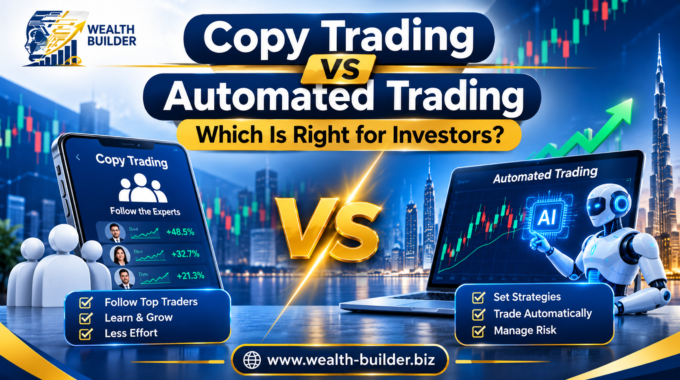
Copy Trading vs Automated Trading Software: Key Differences
The debate around copy trading vs automated trading software is growing fast among investors who want market exposure without watching charts all day. This guide from Wealth Builder explains how each model works and where each one fits. It also covers the risks so that you can decide with a clear head.
Wealth Builder created this comparison for investors in the UAE and beyond who are tired of vague promises. Both approaches can save time. Neither one removes risk though. The right choice depends on how much control you want and how much monitoring you can handle.
What Is Copy Trading?
Copy trading is a method where your account mirrors the trades of another trader. When that trader opens or closes a position your account does the same thing in proportion to the capital you allocated. Wealth Builder describes it as following a person rather than following a rulebook.
How Copy Trading Works
You pick a lead trader on a platform and set the amount you want to allocate. After that the platform copies their actions automatically. Wealth Builder suggests that investors compare drawdown and trading history instead of looking only at monthly returns. A strong month does not prove a sound strategy.
Copy trading grew out of mirror trading which appeared in the early 2000s. Mirror trading copied a strategy while modern copy trading copies actual trades. Wealth Builder notes that this shift made the model far easier for beginners to understand.
Benefits of Copy Trading
The biggest advantage is a lower learning curve. Beginners can watch experienced traders and learn from real decisions. Wealth Builder also points out that you can follow several traders at once and spread risk across different styles.
Limitations of Copy Trading
You depend completely on another person. If the lead trader takes a loss then your account takes it too. Followers also cannot exit faster than the lead trader even when they spot trouble first. Wealth Builder reminds investors that execution delays and slippage can make follower results differ from the lead trader’s results.
Leaderboards can be misleading as well. They often show survivors and hide the traders who failed. Wealth Builder therefore advises caution with any ranking that highlights returns without showing the risk taken to earn them.
What Is Automated Trading Software?
Automated trading software places orders based on rules that are defined in advance. These rules can cover entry points and exit points and position size and stop levels. Wealth Builder explains that the software follows logic and not a person’s mood or opinion.
How Automated Trading Software Works
You choose or build a strategy and connect the software to a broker or exchange through a secure link. The software then watches the market and sends orders when the conditions match. Wealth Builder recommends trading-only permissions on any connection so that your funds stay protected.
Good systems can also apply fixed risk rules before an order goes out. Examples include a stop distance and a duplicate-signal check and an expiry time. Wealth Builder values this kind of structure because it makes every trade easier to audit later.
AI Trading Systems and Algorithmic Trading Solutions
AI trading systems are a more advanced form of automation. They use data models to adjust signals as conditions change. Algorithmic trading solutions are the wider category that includes simple rule-based bots and AI-driven tools. Wealth Builder advises investors to ask how any system was tested and how it behaves in different market phases because a smart label does not guarantee better results.
Benefits of Automated Trading Software
Automation brings discipline and speed. Software can operate around the clock which matters in markets that never close. Wealth Builder highlights that rules also remove emotional decisions such as panic selling. You also decide the size and the symbols and the timing so control stays with you.
Copy Trading vs Automated Trading Software: Key Differences
The core difference is simple. Copy trading mirrors another trader’s decisions while automated trading software executes a defined set of rules. Wealth Builder uses the table below to show how the two approaches compare at a glance.
| Factor | Copy Trading | Automated Trading Software |
| Who decides the trade | A lead trader | Rules or signals you choose |
| Level of control | Limited to the lead trader’s actions | Higher when rules are visible |
| Learning curve | Low | Moderate |
| Main dependency | One trader or a group of traders | Strategy quality and technical setup |
| What to monitor | Trader performance and drawdown | System health and execution quality |
| Key risk | Strategy changes and deep drawdowns | Overfitting and slippage and downtime |
| Typical costs | Subscription or profit share plus spreads | Software fees and infrastructure and spreads |
Control and Decision Making
In copy trading the lead trader holds the steering wheel. You choose who to follow and how much to allocate but you do not choose each trade. Automated trading software puts the rulebook in your hands. Wealth Builder sees this as the biggest dividing line because control shapes every other part of the experience.
Automation and Execution
Both models execute trades automatically but the trigger is different. Copy trading reacts to a person while automated software reacts to conditions. Wealth Builder notes that copy trading can suffer timing gaps between the lead trader and the follower. Software on the other hand acts on its own signals straight away.
Risk Management
Risk in copy trading depends on who you follow and the limits you set. Risk in automated trading software depends on the rules you program. Wealth Builder encourages position sizing and maximum drawdown limits in both cases because neither model protects you from market volatility.
Costs and Transparency
Copy trading may involve performance fees or subscriptions on top of normal spreads. Automated software may carry subscription costs and platform fees and server costs. Wealth Builder suggests checking the total cost before committing capital because slippage and fees can reduce the results of any strategy.
Copy Trading vs Automated Trading Software UAE: What Investors Should Know
More investors in the UAE have started comparing both models since the regulatory changes of 2026. Wealth Builder believes that understanding the rules is just as important as understanding the technology. This applies to copy trading UAE users and to anyone using automated trading software UAE providers offer.
The Regulatory Landscape
On 1 January 2026 the Capital Market Authority replaced the Securities and Commodities Authority under new federal decree laws. Wealth Builder advises investors to note that firms within scope must regularise their position by 1 January 2027 unless the CMA Board grants an extension. The new regime also restricts trading of virtual assets for investment purposes to assets that are approved and registered.
Check Licensing Before You Invest
It’s important to confirm that any provider is properly licensed for the services it offers. Wealth Builder recommends asking for licence details and reading the risk disclosures before funding any account. UAE regulators also introduced a licensing regime for finfluencers in 2025 so social media tips deserve extra scrutiny.
Automated Trading Risks Every Investor Should Understand
Automated trading risks are real and they deserve as much attention as the benefits. Wealth Builder believes that honest risk education builds more trust than bold promises.
Overfitting and Backtest Traps
Overfitting happens when a strategy is tuned so tightly to past data that it fails on new data. A backtest can look impressive on paper and still perform badly in live markets. Wealth Builder warns that a perfect win rate or an unrealistically smooth equity curve is a red flag. Reliable tests include realistic costs and slippage and drawdowns.
Slippage and Hidden Costs
Orders may not fill at the expected price especially when liquidity is thin. Wealth Builder reminds investors that spreads and commissions and subscription fees all reduce net results. A strategy that looks profitable before costs can lose its edge after them.
Technical Failures and Monitoring
Software can face downtime and API errors and duplicate orders. Exchange outages can also stop execution. Wealth Builder recommends starting with small trade sizes or paper trading and keeping a manual override or kill switch. A short daily review of profit and loss and open positions and system health is a smart habit.
Risks Shared by Both Models
Market volatility and leverage and capital loss apply to both approaches. Wealth Builder stresses that past performance does not guarantee future results. Nobody should invest money that they cannot afford to lose.
Copy Trading vs Automated Trading Software: Which Is Right for You?
Choose Copy Trading If You Want Simplicity
Copy trading suits investors who are new to markets and want to learn by observing. Wealth Builder sees it as a fit when you have limited time and feel comfortable relying on another trader’s judgment. You still need to review the trader’s performance regularly.
Choose Automated Trading Software If You Want Control
Automated trading software suits investors who want rules they can inspect and adjust. It works well for those who value consistency and are willing to monitor performance. Wealth Builder recommends it for people who think in terms of risk limits and repeatable processes.
Consider a Blended Approach
Some investors combine both models. They keep a core in rules-based automation and a smaller portion in copy trading. Wealth Builder suggests testing each approach with a small amount of capital first and then scaling only after the results are clear.
How to Evaluate Any Trading Provider
Wealth Builder suggests a simple checklist. Start with licensing and transparency. Then check the verified track record and the drawdown history and the fee structure. Finally confirm that you can pause or stop at any time and that support is available when something goes wrong.
Frequently Asked Questions About Copy Trading vs Automated Trading Software
Is copy trading safer than automated trading software?
Neither is automatically safer. Copy trading carries the risk of another person’s decisions while automation carries the risk of weak rules or technical faults. Wealth Builder encourages investors to judge each option by its risk controls and not by its marketing.
Can automated trading software guarantee profits?
No. Markets are uncertain and any system can produce losses. Wealth Builder advises investors to be wary of any provider that promises guaranteed returns.
Do I need experience to use automated trading software in the UAE?
You do not need to be an expert but you should understand basic risk concepts such as position sizing and drawdown. Wealth Builder recommends learning the fundamentals and starting small before scaling up.
Can I use copy trading and automated trading together?
Yes. Many investors split their capital between the two. Wealth Builder suggests using separate accounts so that manual activity does not interfere with automated activity.
Final Thoughts on Copy Trading vs Automated Trading Software
The choice between copy trading vs automated trading software comes down to control. Copy trading offers a simple path built on another trader’s skill. Automated trading software offers a rule-based path built on your own choices. Wealth Builder believes the best decision is an informed one that matches your goals and your risk tolerance and your time.

Related Posts



Comments (0)