
Copy trading mirrors another trader, while automated trading software follows rules you choose. Compare control, costs, risks and UAE regulation before you decide.
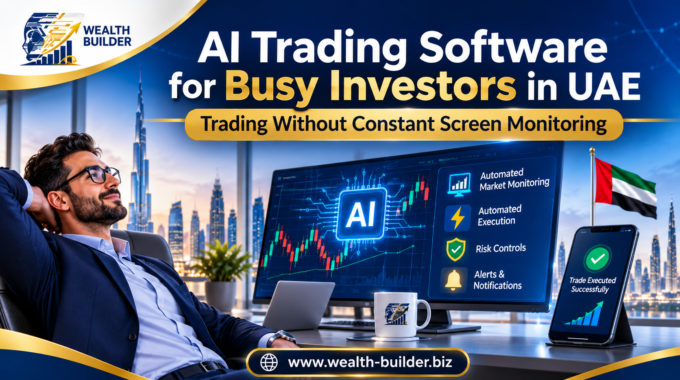
AI Trading Software for Busy Investors in UAE
Dubai and Abu Dhabi professionals rarely have hours to spend watching charts. Between meetings, travel and family time, markets can move while nobody is looking. That is why AI trading software for busy investors UAE has become a common search: people want a way to stay invested without being tied to a screen.
Software can monitor markets and place orders by rule, around the clock and without emotion. It cannot remove risk, and it cannot be left completely alone. This guide explains what hands-free trading really means, where automation helps, where it fails and what to check before you trust any platform.
Why Constant Screen Monitoring Does Not Work
Watching a screen all day is tiring and tends to push people into reactive decisions. Fear after a drop and excitement after a rally often lead to trades that break the original plan. Time zones add another problem. Many markets trade through the night in the UAE, and nobody can watch them all.
What Automation Changes
Automated trading uses an algorithm to open and close positions on your behalf based on predefined parameters. IG describes the main advantages as rules that remove emotion, strategies that can be backtested on historical data and orders that execute faster than manual trading (IG).
What Automation Does Not Change
The same IG guide warns that systems need constant monitoring to confirm the algorithms work correctly. Automation moves your effort from watching every price to supervising a system. That is a lighter task, but it is still a task.
What AI Trading Software for Busy Investors in UAE Actually Does
Hands-free trading software combines three jobs. It monitors markets against your rules, it executes orders when those rules trigger and it enforces risk limits. AI features may add pattern recognition or adaptive signals on top, but the underlying rules and limits still decide what the system is allowed to do.
Automated Market Monitoring
Automated market monitoring means the software checks prices, indicators and conditions continuously and alerts you or acts when a defined event happens. This replaces staring at charts with a short list of conditions that matter to your strategy.
Automated Execution
Execution is where rules become orders. Good software places, adjusts and closes trades exactly as designed. Alpaca warns that the strategy’s theoretical trades may differ from what the order-entry component actually executes, so testing on a demo account or at small size is essential (Alpaca).
Risk Controls
Risk controls are the most important feature for someone who is not watching. They include position-size limits, stop rules and a maximum daily loss. Be aware that stop orders can fail to execute when market conditions prevent it, so limits should never be your only safeguard.
Key Features of AI Trading Software for Busy Investors in UAE
| Software feature | What it does for a busy investor | What to check |
| Automated market monitoring | Watches prices, indicators and events against your rules around the clock | Which markets and data feeds it covers |
| Alerts | Sends a message when a rule triggers or something fails | Delivery channel and how fast alerts arrive |
| Rule-based execution | Places and closes orders without manual input | Whether orders match the strategy you tested |
| Risk controls | Position limits, stop rules and a daily loss cap | Whether limits are enforced automatically |
| Logs and reporting | Records every signal and trade | Whether you can audit what it did and why |
| Manual override | Lets you pause or close everything at once | Whether it works from your phone |
Practical Example: Why How Fast You Notice a Failure Matters
Busy investors often assume the main risk is a bad strategy. A less obvious risk is a silent technical failure, such as a terminal that disconnects or an automated trading switch that has been turned off. An MQL5 analysis argues that downtime depends mostly on how quickly you notice a problem, not how often problems occur (MQL5). If you check every X hours, a failure at a random time waits about X/2 hours before you see it.
The table below applies that rule to an assumed month with one silent failure and about 520 trading hours (a market open 24 hours, 5 days a week). The figures are illustrative assumptions, not a forecast.
| Assumed: 1 silent failure a month, about 520 trading hours | Average hours lost | Share of the month |
| Check once a week (every 120 hours) | 60 | 11.5% |
| Check once a day (every 24 hours) | 12 | 2.3% |
| Phone glance every 4 hours | 2 | 0.4% |
| Alert within about 2 minutes | 0.03 | Under 0.01% |
The lesson is practical. A weekly check leaves the system down for roughly 11.5% of the month on average, while an alert that arrives within minutes cuts that to almost nothing. For someone who is not watching, a good alerting setup is worth more than another indicator. Note that the source is a vendor article promoting its own monitoring products, so treat the numbers as an illustration of the logic and not as proof of any product’s results.
Risks of Trading Without Constant Monitoring
- Technical failures: Alpaca notes that software can miss orders after a connection loss, power cut or crash, and that systems need oversight to catch errant, missing or duplicate orders.
- Over-optimisation: a strategy fitted too closely to historical data can look excellent in a backtest and fail live.
- Backtests are not live results: IG warns that backtest results may not reflect live trading.
- Fast markets: algorithms cannot read news the way people do and can amplify sharp moves. IG cites the 2010 flash crash and the 2011 Knight Capital software failure as examples.
- Leverage: trading CFDs with leverage can cause losses that exceed your initial deposit.
- Over-trust: the biggest behavioural risk is assuming that hands-free means risk-free.
A Simple Supervision Routine for Busy Investors
You can run an automated setup in a few minutes a day if the routine is clear. A sensible structure looks like this:
- Set limits first: decide maximum position size, daily loss and total drawdown before you switch anything on.
- Start on a demo account: run the system with no real money until its behaviour matches your expectations.
- Go live small: begin with a fraction of the intended capital.
- Turn on alerts: make sure failures and limit breaches reach your phone immediately.
- Review weekly: read the trade log and compare results with the tested expectation.
- Know how to stop it: confirm you can pause everything from your phone at any time.
Choosing AI Trading Software for Busy Investors in UAE
Check the Licence
Regulation matters more when you are not watching. UAE financial activity is overseen by authorities such as the Securities and Commodities Authority (SCA) and, in the financial free zones, the DFSA in DIFC and the FSRA in ADGM. The SCA has warned the public about firms using forged licences (Gulf News), so confirm any provider’s licence directly with the regulator and not from the provider’s own website alone.
Questions to Ask Any Provider
- Which regulator licenses you and what is the licence number?
- Can I see live, verified results and not only backtests?
- What costs apply, including spreads, commissions and platform fees?
- What happens if the system or my connection fails?
- Can I stop it instantly and keep control of my own funds?
- Who is responsible if an order is executed incorrectly?
Red Flags to Avoid
- Promises of guaranteed or fixed returns.
- Pressure to deposit quickly or to invest more after a loss.
- No clear licence or a licence you cannot verify.
- Only screenshots or backtests as proof of performance.
- Requests for access to withdraw your funds.
- Claims that you never need to check the system.
Frequently Asked Questions About AI Trading Software for Busy Investors UAE
What is AI trading software for busy investors?
It is software that monitors markets, applies predefined rules and can place trades automatically so you do not have to watch screens all day. AI components may help analyse data, but the rules and risk limits decide what it does.
Can I trade without checking my screen at all?
Not safely. Automation reduces how often you need to look, but systems need monitoring and alerts. A short regular review is still required.
Is automated trading for investors in the UAE profitable?
No one can promise that. Results depend on the strategy, costs, market conditions and risk controls, and backtested performance does not guarantee future results.
What is automated market monitoring?
It is software that continuously checks prices and conditions against your rules and alerts you or acts when a rule triggers.
Do I need a VPS for hands-free trading?
Software running on a home computer can stop after a power cut or connection loss. Many traders use a remote server for always-on operation, together with alerts that tell them when something stops.
How much time does supervising an automated system take?
It depends on the strategy, but a daily glance at alerts and a weekly review of the trade log is a common starting point.
How do I choose a provider in the UAE?
Verify the licence with the regulator, ask for live verified results, understand all costs and test on a demo account first.
Final Thoughts on AI Trading Software for Busy Investors in UAE
Busy investors do not need to give up on markets, and automation can make a disciplined plan easier to follow. The right AI trading software for busy investors UAE setup has clear rules, strict risk limits, fast alerts and a verifiable record. Test it on a demo account, start small and keep a short supervision routine so that hands-free never becomes unattended.
Book a Free Consultation
Want to see how automation and risk controls could fit your schedule and goals? Book a free Wealth Builder consultation.
Book a Free Wealth Builder Consultation
Sources

Related Posts
Comments (0)