Recession-Proof Wealth: 2026 Guide
Recession-Proofing Financial Success: Strategic Asset Allocation in Volatile Markets (2026 Guide)
In the current financial landscape of 2026, the traditional definitions of “safety” have shifted. With global markets characterised by “higher-for-longer” interest rates, rapid AI-driven productivity gains, and persistent geopolitical shifts, the old 60/40 portfolio is no longer the ironclad shield it once was.
Achieving financial success today requires more than just saving; it requires Strategic Asset Allocation (SAA)—a disciplined method of balancing risk and reward by adjusting the percentages of every asset in an investment portfolio according to your risk tolerance, goals, and investment horizon
The New Reality of Volatility in 2026
Volatility is often viewed as a threat, but for the strategic investor, it is a source of opportunity. The volatility we see today isn’t just “noise”; it is the market pricing in a massive structural transition toward an automated, decentralised economy.
To recession-proof your financial success, you must move away from reactive selling and toward proactive positioning. This guide explores the sophisticated frameworks implemented by elite investors to protect capital while capturing the unique growth drivers of the mid-2020s.
I. The Pillars of a Resilient Portfolio
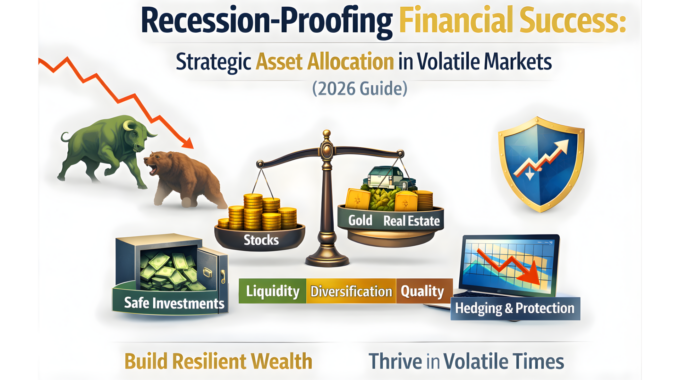
A recession-proof strategy is built on three foundational pillars: Liquidity, Diversification, and Quality.
1. Prioritising Quality Cash Flow
In a high-interest-rate environment, “growth at any cost” is a recipe for disaster. Recession-proofing starts with “Quality” equities—companies with low debt-to-equity ratios, high margins, and, most importantly, consistent free cash flow. These firms can self-fund their growth even when credit markets freeze up.
2. Modern Diversification: Moving Beyond Stocks and Bonds
Diversification in 2026 must include non-correlated assets. When the stock market dips, you need assets that move independently. This includes:
- Private Credit: Offering higher yields than public bonds with lower volatility.
- Real Assets: Such as infrastructure and specialised real estate (data centres and logistics hubs).
- Managed Futures: Strategies that can profit from both rising and falling trends.
3. The Liquidity Buffer
A common mistake during a downturn is being forced to sell assets at a loss to cover living expenses or margin calls. A strategic allocation always maintains a “Liquidity Bucket”—typically 6 to 12 months of operating capital in high-yield cash equivalents—ensuring you never become a “forced seller.”
II. Strategic Asset Allocation: The 2026 Framework
How should a modern portfolio look when the economic clouds gather? While every individual’s needs differ, the following framework represents a “Resilient Growth” model for 2026.
The “Core and Satellite” Approach
- The Core (70%): This is your foundation. It consists of low-cost broad market ETFs, high-quality corporate bonds, and inflation-protected securities. The core is designed to capture the steady upward drift of the global economy.
- The Satellite (30%): This is where you tilt your portfolio toward specific opportunities. In 2026, this often includes a “Tech-Sleeve” focusing on AI infrastructure and a “Defensive-Sleeve” focusing on healthcare and consumer staples.
Table: Sample Strategic Allocation for Volatile Times
|
Asset Class |
Targeted Weight |
Primary Objective |
|
Quality Equities (Global) |
45% |
Long-term capital appreciation |
|
Short-Duration Fixed Income |
20% |
Capital preservation & liquidity |
|
Real Assets (Gold/Commodities) |
10% |
Inflation and geopolitical hedge |
|
Private Markets/Alternatives |
15% |
Non-correlated income |
|
Cash/Money Markets |
10% |
Opportunistic buying power |
III. Defensive Tactics: The “Barbell” and the “Ladder”
Strategic allocation isn’t just about what you own; it’s about how you structure it to handle stress.
1. The Equity Barbell
To navigate 2026, many lead strategists use a “Barbell Strategy.” On one end, you have high-conviction growth stocks (the “AI Gold Rush”). On the other hand, you have ultra-stable, high-dividend-paying utilities and value stocks. This structure allows you to participate in the upside of innovation while the “boring” side of the barbell provides a floor during a recession.
2. The Fixed-Income Ladder
With interest rates remaining volatile, “Laddering” your bonds is essential. By buying bonds that mature at different intervals (e.g., 1, 3, 5, and 10 years), you ensure that you always have cash coming due to reinvest at potentially higher rates, or to use as a safety net if the equity markets crash.
IV. The Psychology of Success: Overcoming Behavioural Traps
The greatest threat to a recession-proof portfolio isn’t a market crash—it’s the investor’s reaction to it. Financial success is 20% head knowledge and 80% behavior.
Beware of “Recency Bias”
When the headlines are red, human instinct suggests the trend will continue indefinitely. Strategic investors use Automated Rebalancing. By setting a rule to rebalance your portfolio every time an asset class drifts 5% from its target, you are mathematically forced to buy low and sell high, removing the emotional burden of the decision.
The Power of “Time-In” vs. “Timing”
Trying to time the bottom of a recession is a fool’s errand. Data from the last 50 years shows that missing just the 10 best days in the market can cut your long-term returns in half. A strategic allocation ensures you stay “in the game” so you are present for the inevitable recovery.
V. Advanced Protection: Hedging and Tail-Risk
For those with significant capital, “Tail-Risk Hedging” has become a standard part of the 2026 toolkit. This involves using modest positions in “Put Options” or “Inverse ETFs” that pay out specifically during a market crash.
Think of this as an Insurance Premium. You hope you never need it, but if a “Black Swan” event occurs, the gains from these hedges can offset the losses in your core equity holdings, keeping your net worth stable.
Conclusion: Wealth is Built in Recessions
History shows that the greatest leaps in wealth happen not during the “easy” bull markets, but during the pivots of a recession. By employing Strategic Asset Allocation, focusing on Quality, and maintaining Behavioural Discipline, you transform volatility from a risk into a tool for long-term success.
The most successful investors of 2026 aren’t those who predicted the recession, but those who were structured to survive it.
Sources: Black Rock & JPMorgan

Related Posts