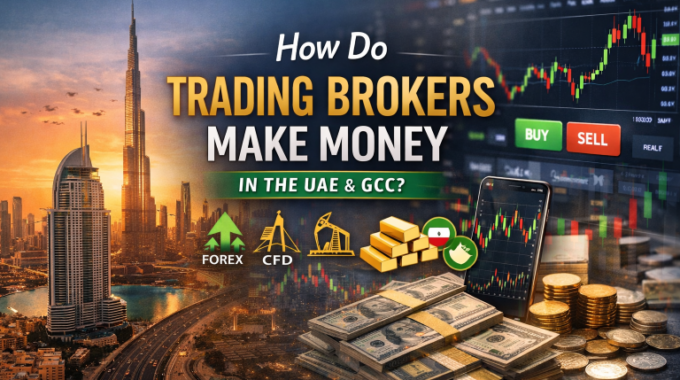
How do Trading Brokers Make Money in the UAE?
How Do Trading Brokers Make Money in the UAE? (Complete GCC Guide 2026)
Introduction
If you trade forex, CFDs, shares, or indices in the UAE, you’ve probably asked: How do trading brokers make money?
Whether you’re using a forex broker in Dubai, a CFD broker regulated by the DFSA, or an international broker serving GCC clients, understanding broker revenue models is critical.
In this guide, we explain how trading brokers in the UAE earn money, the difference between spreads, commissions, and swap fees, broker execution models, and how to reduce trading costs in 2026.
What Is a Trading Broker in the UAE?
A trading broker is a financial intermediary that gives retail and professional traders access to global markets, including forex, shares, indices, commodities, ETFs, and CFDs.
In the UAE, brokers may be regulated by the Dubai Financial Services Authority (DFSA) or the Securities and Commodities Authority (SCA). Choosing a regulated broker in Dubai or the GCC is essential for fund protection and compliance.
1. The Spread (Main Revenue Source)
The spread is the difference between the buy price (ask) and the sell price (bid).
Spread = Ask Price – Bid Price
For example, if USD/JPY shows a bid of 150.200 and an ask of 150.220, the 2-pip difference is the broker’s spread.
Tight spreads are critical for scalpers and intraday traders in Dubai and across the GCC.
2. Commission Fees
Some UAE trading brokers charge commission, especially on share CFDs, direct share trading, or raw spread forex accounts.
Commission may be fixed per lot, a percentage of trade value, or per share pricing.
3. Overnight Funding (Swap Fees)
If you hold leveraged positions overnight, brokers charge a funding fee.
Overnight Fee = Position Size × Funding Rate
This applies to forex trades, CFD positions, spot indices, and commodities.
Many UAE brokers offer swap-free Islamic accounts compliant with Shariah principles.
4. Deposit and Withdrawal Fees
Some brokers charge fees for international bank transfers, card withdrawals, or currency conversion.
Competitive UAE brokers often offer free AED deposits and withdrawals via local banking channels.
5. Guaranteed Stop-Loss Premiums
A guaranteed stop-loss protects traders from slippage during high volatility or weekend gaps.
If triggered, a small premium applies.
Broker Business Models in the GCC
There are three main execution models used by brokers: A-Book, Hybrid (Internalisation), and B-Book.
1. A-Book Model (Hedging Model)
In this model, the broker passes your trade to liquidity providers.
Client Position → Liquidity Provider
The broker earns from spreads or commissions rather than client losses.
2. B-Book Model (Market Maker Model)
The broker takes the opposite side of your trade. If you lose, they profit. While legal, traders should ensure the broker is well-regulated and transparent.
3. Hybrid Model (Internalisation)
The broker matches buy and sell orders internally and hedges remaining exposure externally.
Trading Broker vs Stockbroker in the UAE
Trading brokers typically offer forex, CFDs, indices, and commodities with leverage. Traditional stockbrokers mainly offer share trading and rely on commission-based pricing.
What UAE & GCC Traders Should Look For in 2026
When choosing a trading broker in the UAE, consider DFSA or SCA regulation, competitive spreads on US30 and Gold, transparent commissions, Islamic account options, fast AED withdrawals, and strong execution quality.
Final Thoughts
Understanding how trading brokers make money helps UAE and GCC traders reduce costs, improve profitability, and choose transparent, well-regulated brokers.
Always compare spreads, commissions, funding fees, and execution models before opening an account.
Sources: Investopedia & Wikipedia & IG Markets

Related Posts