How AI Can Help Traders Make Money in the UAE?
How AI Can Help Traders: A Complete Guide to Smarter Market Analysis
Introduction
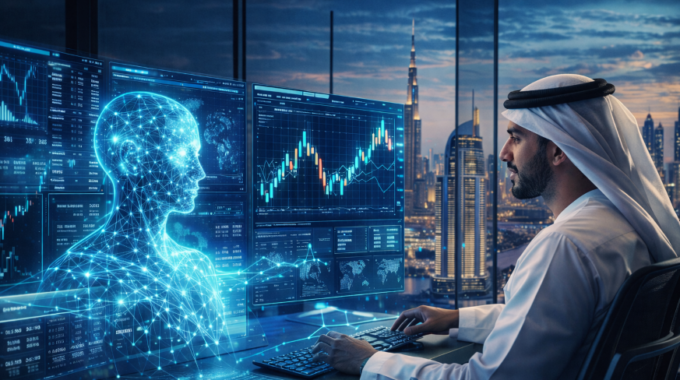
Artificial Intelligence (AI) is revolutionising the trading landscape, offering traders unprecedented capabilities to analyse markets, execute trades, and manage risk. By acting as a high-speed, 24/7, emotion-free analyst, AI processes vast datasets and identifies patterns faster than humanly possible. Unlike traditional fixed-rule algorithms, modern AI systems adapt and learn from market data, continuously improving their performance over time.
Whether you’re a retail trader or institutional investor, understanding how AI can enhance your trading strategy is essential in today’s data-driven markets. This guide explores the practical applications of AI across the trading lifecycle, the tools available, and the critical considerations for successful implementation.
1. Market Research and Analysis
AI transforms market research by processing information at speeds no human can match. Here’s how:
Rapid Data Processing
AI systems analyse immense volumes of data—including earnings reports, news articles, and social media conversations—within seconds to identify emerging trends and market-moving events.
Sentiment Analysis with NLP
Natural Language Processing (NLP) tools scan platforms like Reddit, X (formerly Twitter), and financial news to gauge market mood. By quantifying public sentiment, AI can anticipate potential price movements before they occur.
Alternative Data Insights
Forward-thinking traders leverage AI to analyse non-traditional data sources. Satellite imagery of retail parking lots, web traffic patterns, and credit card transaction data can provide early indicators of company performance.
Pattern Recognition
AI scans millions of data points across multiple timeframes to identify technical chart patterns—such as cup and handle formations or head and shoulders patterns—that may signal future price directions.
2. Strategy Development and Testing
Building and refining trading strategies becomes significantly more efficient with AI assistance:
Back-testing
AI tools instantly run historical simulations on trading strategies, allowing traders to evaluate performance against years of market data before committing real capital. This validation process is crucial for strategy refinement.
Strategy Optimization
Machine learning algorithms analyze past performance to optimize key parameters—including entry and exit points, stop-loss levels, and profit targets—maximizing potential returns while managing risk.
Scenario Testing
AI simulates portfolio performance under various market conditions, from high volatility environments to interest rate shifts, helping traders prepare for different market scenarios.
3. Automated Trade Execution
AI-powered execution systems offer distinct advantages in modern markets:
High-Frequency Trading (HFT)
Sophisticated algorithms execute large volumes of trades within milliseconds, capitalising on tiny price discrepancies that exist for only fractions of a second. This speed advantage is impossible to achieve manually.
24/7 Market Monitoring
AI trading bots never sleep. They continuously monitor global markets across different time zones, ensuring trading opportunities aren’t missed during off-hours.
Smart Order Execution
AI-driven execution models reduce transaction costs by finding optimal prices and timing for large orders, minimising market impact and improving overall trade performance.
4. Risk Management and Portfolio Optimisation
Perhaps most importantly, AI enhances risk management capabilities:
Emotionless Decision-Making
By removing fear and greed from trading decisions, AI ensures actions are based purely on logic and data analysis, preventing emotional trading mistakes.
Risk Detection
AI algorithms identify unusual trading volumes or price anomalies that might signal market manipulation or significant institutional moves, allowing traders to adjust positions accordingly.
Dynamic Portfolio Rebalancing
AI tools continuously monitor portfolio allocations and suggest—or automatically implement—adjustments to maintain desired risk profiles as market conditions evolve.
5. Key AI Tools and Technologies
Several AI-powered platforms are transforming how traders operate:
Generative AI Assistants
Tools like ChatGPT and Claude help traders summarise lengthy financial reports, explain complex market concepts, and generate code for trading strategies (such as Pine Script for TradingView).
Specialised Trading Platforms
TrendSpider: Provides automated technical analysis and pattern recognition
Tickeron: Delivers AI-powered trading insights and predictions
Kavout: Uses machine learning for stock ranking and analysis
Machine Learning Models
Advanced ML algorithms analyse historical data to predict price movements and identify non-obvious market relationships.
6. Risks and Considerations
While powerful, AI trading tools come with significant risks:
Overfitting Danger
Models that perform perfectly on historical data often fail in live markets because they’ve learned noise rather than genuine patterns. This is the most common pitfall in AI trading.
Garbage In, Garbage Out
AI predictions are only as reliable as their training data. Flawed, incomplete, or outdated data produce unreliable outputs, regardless of model sophistication.
Black Box Problem
Many AI systems don’t explain their reasoning, making it difficult for traders to understand why specific recommendations are made. This lack of transparency can be problematic for regulatory compliance and risk management.
Black Swan Events
Models trained exclusively on historical data cannot predict unprecedented events. Sudden market shocks—like the COVID-19 crash or flash crashes—may catch AI systems completely off guard.
Conclusion
AI represents a transformative force in trading, offering powerful capabilities for market analysis, strategy development, execution, and risk management. However, the most effective approach treats AI as a “co-pilot” or research assistant rather than a complete replacement for human judgment.
The optimal trading strategy combines AI’s computational power and data processing capabilities with human oversight and strategic decision-making. By using AI to automate repetitive tasks and generate actionable insights—while maintaining control over overall strategy and risk parameters—traders can harness the best of both worlds.
As AI technology continues to evolve, successful traders will be those who learn to collaborate effectively with these powerful tools, adapting their approaches as both markets and technology advance.
Sources: Investopedia, Wikipedia, & TradingView

Related Posts